

Buying advice
How to narrow down the right car for you
13 min read
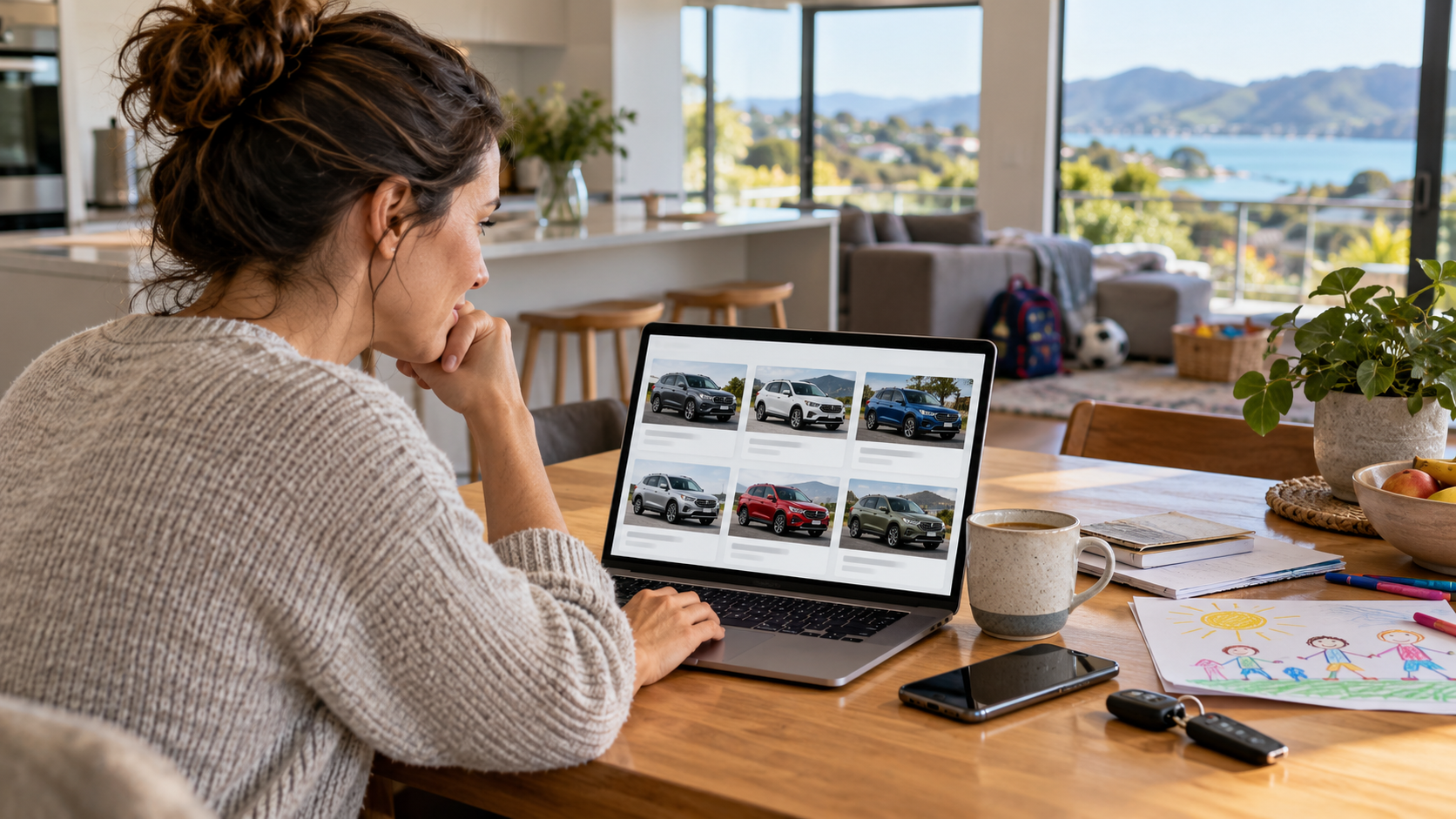
Buying a car should be easier than it used to be. There are thousands of listings, reviews for almost everything and enough specification data online to compare two boot openings to the millimetre.
Yet all that information can make the decision harder rather than easier.
Set a sensible budget, choose automatic and start looking for a family car and you can quickly find yourself comparing a Mazda CX-5 with a Toyota RAV4, Hyundai Tucson, Kia Sportage, Nissan X-Trail, Mitsubishi Outlander, Subaru Forester and several hundred individual vehicles that all appear to be perfectly reasonable choices.
That isn't a shortage of options. It's a shortage of reasons to eliminate them.
If you've found yourself asking “what car should I buy?”, the answer usually isn't to search harder. It's to narrow the decision in the right order.
That doesn't mean pretending people choose cars like a procurement department chooses photocopiers. Sometimes you simply see a car and think, that's what I want next.
That's a perfectly good place to start.
Sometimes the car comes first
Not every buying decision begins with a careful analysis of passenger numbers, luggage volume and total cost of ownership.
You might see a CX-5 in a car park and like it. Your neighbour might have a RAV4. You might borrow a friend's Outback for the weekend and decide it feels exactly right.
Cars are practical purchases, but they're emotional ones too. There is nothing wrong with wanting something because you like the way it looks, drives or makes you feel.
“I want a CX-5” is therefore a perfectly reasonable starting point. It just isn't yet a complete buying brief.
Which CX-5? Petrol or diesel? How old? How many kilometres are you comfortable with? AWD or front-wheel drive? Which features matter? What would you happily compromise on for a cleaner, lower-kilometre example?
Those questions turn “I like that” into something you can actually shop for.
Sometimes you don't know which questions matter
When we first experimented with a freeform request at AutoMatch, my wife Paula filled one out for the Mazda CX-5 we were looking for.
We had already decided a diesel Mazda wasn't an option. But when she wrote the request, she didn't specify petrol.
She hadn't changed her mind. She simply didn't think to mention it.
That was useful.
Not everyone is a car person, and even people who know roughly what they want can overlook something important because they don't realise it needs to be specified.
Fuel type is obvious once somebody asks you. So is transmission. Maximum kilometres. Minimum year. Whether you need seven seats. Whether adaptive cruise actually matters. Whether there's a feature you actively don't want.
Part of a good buying process is asking those questions before the market starts throwing cars at you.
That's why AutoMatch doesn't simply give you a blank box and ask you to describe your dream car. The request works through the things you need to think about so the car that eventually turns up is actually right for you.
You don't need to know all the right questions before you start. That's rather the point.
Check that the car you want fits the life you actually live
Even if you've already got a model in mind, it's worth checking that it suits what you genuinely do.
How many people does it regularly carry? How much of its life will be commuting? Do you need room for children, dogs, bikes or camping gear? Are you towing? Do you drive long distances? Does it need to fit into tight parking every day?
There is a difference between buying for your real life and buying for the version of it featured in the brochure.
You may genuinely need seven seats. Or you may need them twice a year when the grandparents visit.
You may genuinely need AWD. Or its most difficult assignment may be wet grass at school sports day.
You may need a ute tray for work. Or you may simply like owning something that looks ready to repair a fence on the way home.
None of those choices is wrong. But it helps to know which one you're making.
“I need an SUV” is a conclusion. “I need room for two children, a dog, holiday luggage and something comfortable on long trips” is useful information.
If the SUV still makes sense after that, excellent.
Do a little homework before committing to a model
Once a particular car starts looking serious, spend a little time researching it.
You don't need to disappear into an owners' forum for three weeks. A quick search for the model, engine and “common problems” will normally surface the things worth knowing about.
But read the results with some perspective.
People are understandably quick to post when a gearbox fails, an engine starts using oil or a repair bill arrives with an extra digit in it.
Far fewer people rush to Reddit to announce that their car has completed another entirely uneventful year requiring little more than servicing, tyres and an increasingly offensive amount of petrol.
That doesn't mean reliability reports should be ignored. Repeated evidence of the same expensive problem deserves attention, especially if specialists, recalls, technical bulletins or large numbers of owners are all saying the same thing.
It simply means anecdotes need context.
A handful of angry posts can make a model with hundreds of thousands of examples on the road sound as though every journey ends on a tow truck.
Research the faults. Understand what you're potentially buying. Then put the information back into proportion.
Set some boundaries before the market sets them for you
Budget is the obvious place to start, but year, kilometres, fuel type, transmission and size all matter too.
The trick is deciding which are genuine boundaries and which are preferences.
Because the used-car market has an impressive ability to make you spend more than you intended.
You start at $30,000. Then the $32,000 one is a year newer. The $34,000 one has half the kilometres. The $36,000 one has the better specification. By $39,990 you're explaining to yourself that it's really only another few dollars a week.
Keeping up with the Joneses becomes considerably easier when the finance term is long enough.
That doesn't mean never stretch the budget. Sometimes paying a little more genuinely gets you a much better car. It means deciding beforehand what would justify it.
Otherwise the budget stops being a boundary and becomes the opening offer.
Used cars are a trade-off
This is the part that gets lost in a lot of buying advice.
Used cars are compromises.
At the same price, you might be choosing between a newer car with higher kilometres, an older one with fewer kilometres, a higher-spec car that's a year or two older, or a simpler one that's newer and has travelled less.
One may have better tyres. Another may have full service history. One may come with a warranty. Another may have clearly spent its previous life transporting children, dogs and what appears to be half the contents of a compost heap.
None is automatically better.
A 2021 car with 80,000km isn't inherently worse than a 2019 one with 45,000km. How it has been used, maintained and looked after matters.
A newer base model isn't automatically the better buy either if the older car has equipment you genuinely value.
Year, kilometres, price and specification all compete for the same money. Improve one and you often give something up elsewhere.
The trick with a used car isn't avoiding compromise. It's making the compromise deliberately.
Decide what matters and what merely sounds nice
Some requirements are genuinely non-negotiable. If you tow a heavy trailer, towing capacity matters. If you regularly carry six people, seven seats may be essential.
Other things are preferences. Heated seats might be lovely. A panoramic roof may be completely irrelevant. You may strongly prefer one feature but happily give it up for a better overall car.
Weak preferences make terrible filters. It's surprisingly easy to reject a better vehicle because the other one has nicer wheels.
A useful way to think about it is simply to separate what the car must have from what you'd prefer, what doesn't matter and what you actively want to avoid.
That isn't an exercise in filling out forms for the sake of it. It stops relatively trivial things from carrying the same weight as the requirements that actually determine whether the car works for you.
Get down to two or three models
At some point, research has to produce a shortlist.
You don't need to identify the one perfect model before looking at actual cars. Two or three good ones may be better.
Perhaps a CX-5, RAV4 and Tucson all suit what you need. Good. You're no longer comparing every medium SUV sold in New Zealand. You're comparing three vehicles you would genuinely be happy to own.
A shortlist of three good answers is much more useful than 300 technically possible ones.
This is also where people often accidentally restart the whole exercise.
Someone at work says you should look at a Forester. YouTube recommends a Sportage review. A Facebook commenter insists you'd be mad not to buy a European wagon.
Three nights later the shortlist contains nine models and you're reading about gearbox ratios at 11:40pm.
There is always another car, and at some point more information stops improving the decision.
Know when you've looked at enough
Online marketplaces are excellent at showing you what's available. They're less useful at telling you when to stop looking.
Once you've got a sensible shortlist, don't reopen the entire market unless you've learned something important enough to justify it.
A genuine reliability concern is worth reconsidering. So is a new requirement you hadn't thought about. Another vaguely interesting car because an algorithm put it in front of you probably isn't.
A marketplace can show you every car for sale. It can't tell you when you've looked at enough.
You don't need to prove that no other car in New Zealand could possibly suit you. You need to get to the point where several cars suit you well enough to start comparing the actual examples.
And that's where the problem changes again.
How do you compare cars that aren't really comparable?
Imagine you've narrowed the search to three candidates.
There's a 2021 Toyota RAV4 with 82,000km, a 2020 Mazda CX-5 with 47,000km and the higher specification, and a 2022 Hyundai Tucson with more equipment but a slightly higher asking price.
Which one is best?
There isn't a universal answer because they're fundamentally different offers.
One is newer. One has lower kilometres. One may have the features you value most. One may come with a better warranty. Another may simply be better value.
This is where simple search filters start to run out of talent. They can find the cars, but they don't necessarily help you weigh them against one another.
To do that properly, you need one consistent measuring stick: your own requirements.
If low kilometres matter more to you than age, that should affect the result. If adaptive cruise is something you absolutely want, a newer car without it may actually be the worse option. If budget is the priority, accepting another 15,000km may be an entirely sensible trade.
If you're planning to keep the car for ten years, service history and condition might matter considerably more than whether one car is twelve months newer.
The cars are different. The brief is what makes them comparable.
Let the market tell you something
Once your requirements become specific, you may discover there aren't many vehicles that fit them.
That's useful information.
If there are thirty suitable vehicles, you can afford to be picky. If there are three, you're shopping in a narrow part of the market and may need to move when a good one appears.
If there are none, one of your requirements may need another look. Perhaps the budget is a little tight. Perhaps your kilometre limit is eliminating otherwise good vehicles. Perhaps the exact specification you're after simply wasn't sold here in large numbers.
That doesn't mean the search has failed. It means the market has answered a question.
Repeatedly refreshing the same search and hoping a unicorn appears overnight is less a strategy than an increasingly specialised hobby.
This is where AutoMatch starts
AutoMatch isn't designed to tell you which car you should fall in love with. You may already know, or you may have narrowed the field to two or three models that genuinely suit you.
What AutoMatch does first is turn that into a properly defined request. It asks about fuel, transmission, year, kilometres, budget and the features that matter because not everybody arrives knowing which details they need to specify. The Paula petrol example is exactly why.
Then comes the part that is much harder to do manually.
The vehicles that fit your request may be all over the place. One is newer but dearer. Another is older with much lower kilometres. One has almost every feature you asked for but sits slightly above budget. Another is cheap, clean and sensible but misses something you'd prefer to have.
As a collection, they can have quite a lot in common with an end-of-term folder of kindy art: different colours, different shapes, some of them inexplicably brown, and no immediately obvious way of deciding what deserves pride of place.
AutoMatch works through the brief.
Cars that fail something essential are knocked out. The survivors are then weighed against the things you've said matter: price, year, kilometres, features, warranty and the compromises you're prepared to make.
A newer car doesn't automatically beat an older one. Low kilometres don't automatically beat better specification. Being cheapest certainly doesn't guarantee a place.
By the end, the pile has been crunched down to the three that fit you best.
They're the ones that make the fridge.
What happens to the rest after the kids have gone to bed is between you and the recycling bin.
That is what the ranking is there for. Not to claim that one car is universally better than another, but to take a messy collection of genuinely different used cars and work out which ones most closely fit the priorities you gave us.
So what car should you buy?
Maybe you already have a good idea. Maybe you saw one six months ago and thought, that's my next car. Maybe you've narrowed things down to three sensible options and are now trying to work out which compromise makes the most sense.
All of those are perfectly normal places to start.
The important part is turning instinct into a proper brief, doing enough homework to understand what you're considering, deciding what genuinely matters and then judging the real cars against those priorities rather than endlessly reopening the entire market.
You don't need to become an expert on every car sold in New Zealand, and you don't need a vehicle that wins every possible comparison.
You need a small number of genuinely good choices, weighed against what matters to you.
Of course, you can always do it the traditional way: 47 Trade Me tabs open and a Watchlist as long as the queue at Gull on discount day.
We built AutoMatch because we thought there should be a better way.
Hours of research. One simple next step.
Know what you want? Let's find it.
Tell AutoMatch what you're looking for and let the dealer network respond with suitable vehicles.
Related reading
Do you really need a ute to tow a boat?
Looking for the best tow vehicle in NZ? Before buying a ute, work out what your boat really weighs. We compare wagons, SUVs, utes, hybrids and EVs for Kiwi towing.
Best station wagons in NZ 2026: 7 used wagons worth buying
Seven used station wagons compared for price, boot space, rear-seat room, fuel economy, safety and everyday practicality in New Zealand.
Best cars for older drivers in New Zealand
Easy to get into, easy to see out of, easy to park and easy to own. Six vehicles worth a look on the New Zealand market, plus the features and checks that actually matter.