
Buying advice
Do you really need a ute to tow a boat?
11 min read
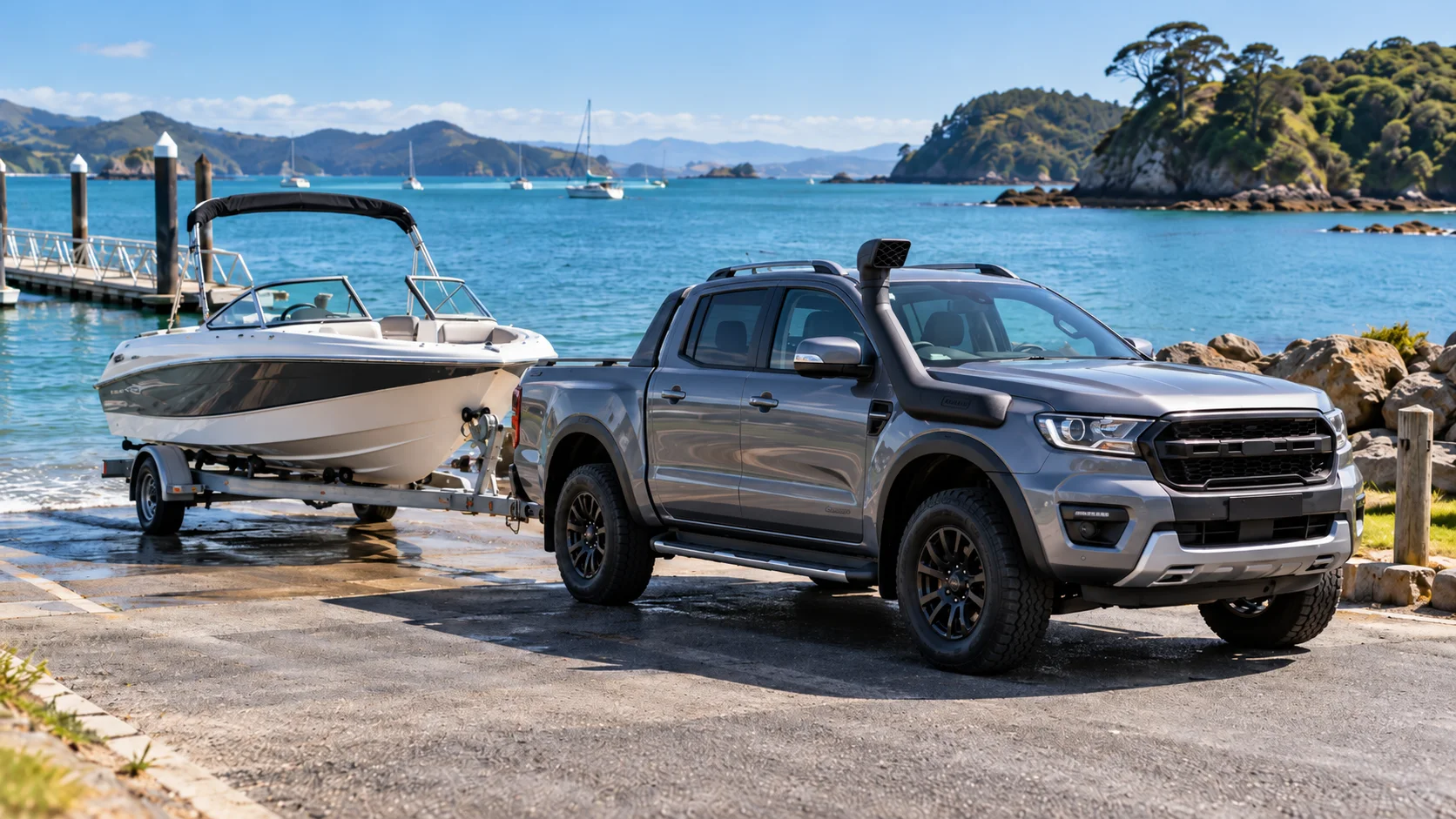
New Zealand has developed a curious relationship with towing. Attach a trailer to almost anything and somebody will suggest you need a ute.
Boat? Ute. Caravan? Ute. Jet ski? Probably a Ranger Wildtrak. Best not take chances.
Which would make perfect sense if every Kiwi boat weighed three tonnes.
They don't.
Most towing advice starts by asking what is the best tow vehicle in NZ? We think that's backwards. The better question is:
How much tow vehicle do you actually need?
Work out what your boat really weighs, where you launch it, how far and how often you tow it, and what you need the vehicle to do for the other 350 days of the year. Then buy enough vehicle for the job.
A maximum tow rating is a ceiling. It isn't a personality trait.
First, find out what your boat actually weighs
Take a proper fibreglass family runabout.
A Haines Hunter SF545 is nearly six metres long overall, carries up to six people and is designed for fishing, family cruising and watersports. Its published standard towing weight is around 1,350kg.[1]
This is not a dinghy with a weed-eater attached to the back. It's a proper family boat.
A smaller Haines Hunter SF485 comes in around 850kg.[2] At the other end, a Haines Hunter 725 sits at roughly 2,500kg before you've loaded it for an actual day on the water.[3]
That spread alone should be enough to kill the idea that “boat” is a useful towing category.
Haines Hunter also points out that its published towing weights are based on basic-spec boats without fuel, water or gear aboard.[4] And boats collect weight with impressive efficiency: fuel, batteries, anchor and chain, lifejackets, wakeboards, fishing gear, chilly bin, tools and whatever has been living under the bow seat since Christmas 2023.
So don't choose your tow vehicle from the empty brochure weight. Find out what the trailer actually weighs when it's ready to go boating.
A 3.5-tonne tow rating is excellent — when you need 3.5 tonnes
A current Ford Ranger can tow up to 3,500kg braked when properly specified.[5] That's an impressive and genuinely useful capability if you're hauling a heavy hardtop, large caravan, machinery or another serious trailer.
But plenty of vehicles without a tray have substantial towing ability too.
A current Subaru Outback is rated to 2,000kg braked, with 200kg maximum tow-ball load and around 213mm of ground clearance.[6] Petrol Nissan X-Trail variants can also tow 2,000kg.[7] Relevant Škoda Superb 4x4 versions reach 2,200kg, while Mazda's CX-60 goes to 2,500kg.[8][9]
None of those figures proves a particular vehicle suits your boat. They do prove something much simpler:
An 850kg or 1,350kg family boat does not automatically require a 3.5-tonne-rated ute.
The unused capacity may give you valuable margin. Or it may simply be unused ambition.
When the ute stops being theatre
There is a point where the ute earns every millimetre of its bonnet.
A heavy boat, high tow-ball load, lots of gear, poor launching surfaces and frequent long-distance towing all move the equation in its favour. Take that larger Haines Hunter 725: at roughly 2,500kg standard towing weight before fuel and gear, a vehicle with a 2,500kg maximum rating no longer gives you meaningful headroom.[3]
Now a Ranger, Hilux, D-Max or another properly rated tow vehicle starts making very good sense. A ute also earns points if you genuinely use the tray for wet ropes, dive gear, bait, tools, fuel containers, bikes or other things you'd rather not introduce to the family upholstery.
A Ranger towing a 2.8-tonne hardtop isn't posing. It's at work. A Ranger towing an 850kg runabout six kilometres to a clean concrete ramp may be compensating for something, but it probably isn't the trailer.
The boat ramp changes the equation
Towing down the motorway is only half the job. Eventually you have to reverse the boat into the water and get it back out again.
On a steep ramp, the extra ride height of an SUV or ute can keep its bumper, exhaust and lower bodywork clear of the water, while a low wagon may find itself exploring the finer points of Archimedes' principle.
A snorkel may look reassuring at the boat ramp. If you actually need it, you're doing the boat ramp wrong.
Then there's traction. Dry concrete is one thing; wet concrete covered in weed is another. Add shingle, loose gravel or sand and AWD, proper 4WD and even low range stop looking like brochure decoration.
A vehicle can have more than enough towing capacity for the road and still be the wrong vehicle for the ramp.
Previous generations approached this rather differently
Kiwi towing calculations haven't always involved quite enough mathematics.
One family story involves retrieving a runabout from the shingle at Momorangi in the Marlborough Sounds using a front-wheel-drive Nissan Primera.
As the shadows started to lengthen and the queue formed at the beach, the Primera stood out like the proverbial dog's balls in a sea of 4WDs and utes.
When traction became marginal, two daughters were placed on the bonnet.
There was a proper 4WD Ford Courier standing by — my dad's, as it happened — if things went badly wrong.
It wasn't needed.
The Primera succeeded with a healthy combination of real-world capability and the boat owner's blind, possibly naive belief that it would.
We are not recommending this.
But it does illustrate how far conventional wisdom has swung: from “the FWD Primera will probably manage” to “we own a boat, better buy something rated to tow a house.”
Somewhere between those two positions is probably the vehicle you actually need.
Unfortunately, sometimes the SUV is the sensible answer
An AWD SUV can be an excellent compromise for towing a modest family boat.
You generally get more ground clearance and better ramp geometry than a low wagon, useful towing capacity, an enclosed luggage area and often more passenger space than a ute.
A petrol Nissan X-Trail can tow up to 2,000kg braked.[7] Relevant Toyota Highlander and Hyundai Santa Fe variants sit in similar territory.[10][11]
Does that make any one of them the best SUV for towing in NZ? No. The boat, ramp, load and exact vehicle specification still matter.
But for somebody towing a 1.3-tonne runabout to ordinary ramps, an AWD SUV may genuinely be the best answer.
We don't have to like it. We do have to admit it.
And yes, a wagon can tow a boat
Now we're back on safer emotional ground.
A properly rated AWD wagon can make a very good tow vehicle where the trailer weight and ramp conditions line up. Relevant Superb 4x4 variants can tow 2,200kg, while some Volvo V60 and V90 AWD versions sit around or above the two-tonne mark depending on drivetrain.[8][12]
The Outback sits rather conveniently between wagon and SUV: essentially a wagon that acquired hiking boots, with AWD, 213mm of ground clearance and a 2,000kg tow rating.[6]
A wagon can also give you something many lifestyle utes surrender in pursuit of capability you may rarely use: car-like road behaviour, an enclosed boot, easier parking and, if you've spent ute money on the right one, a considerably more entertaining engine.
There is something wonderfully unnecessary about towing the family boat with a 200kW-plus AWD wagon.
Then again, unnecessary excess seems to be acceptable when it's expressed as a 3,500kg tow rating, so fair is fair.
Tow rating is only one number
Anyone looking for the best car for towing a boat in NZ needs to go beyond the headline towing figure.
NZTA guidance says a simple trailer should generally put around 10 percent of its laden weight downward on the coupling for stability.[13] That tow-ball load also counts against what the vehicle itself can carry.
Add passengers, luggage, accessories and everything else the family takes away, and payload can disappear quickly. Gross Vehicle Mass and Gross Combined Mass can also become limiting factors before the headline maximum tow rating does.
In other words, towing capacity is part of the calculation, not the whole calculation.
This is one area where a big ute can genuinely regain some ground: substantial towing capacity combined with useful payload matters when the entire combination is heavily loaded.
What about an EV?
Electric motors themselves are extremely well suited to towing. Huge torque from zero rpm is not the problem.
The awkward bit arrives later.
Towing can seriously reduce EV range, especially at highway speeds where the aerodynamics of the trailer matter enormously. In one US test, an electric Ford F-150 Lightning's measured highway range fell by more than half while towing a roughly 1.4-tonne travel trailer.[14]
A boat is not a caravan, and its different shape means you shouldn't simply apply that percentage to every boat trailer. But the lesson is important: an EV can have enough towing capacity without having enough towing range for the journey you want to make.
Charging introduces another practical issue. A charger that's easy to use normally can become considerably less convenient when you arrive with several metres of trailer attached.
Maximum tow rating tells you whether the EV can pull the boat.
Range tells you whether you'll enjoy taking it anywhere.
What about hybrids?
Check the exact drivetrain rather than trusting the badge.
Petrol X-Trail variants, for example, can tow up to 2,000kg, while current e-POWER versions are rated lower at 1,650kg.[7]
That's still enough for plenty of boats, but not all of them.
The same applies more broadly to hybrids and plug-in hybrids: additional battery weight and drivetrain design can change the manufacturer's towing limits substantially. Anyone searching for the best hybrid for towing in NZ needs to compare the exact variant, not assume every version of the same model can tow the same thing.
“The bloke online says his mate tows one with it” remains an unreliable engineering standard.
How much tow vehicle do you actually need?
| Loaded trailer weight | Where we'd start looking |
|---|---|
| Up to ~1,000kg | Cars, wagons and SUVs may all be viable. Ramp conditions may matter more than brute towing capacity. |
| ~1,000–1,500kg | Prime family-runabout territory. Good wagons, AWD crossovers, SUVs and utes can all enter the conversation. |
| ~1,500–2,000kg | Tow-ball load, payload and margin below the vehicle's limits become increasingly important. |
| Above ~2,000kg | The field narrows toward larger SUVs, proper 4WDs and utes. |
| ~2,500–3,500kg | Congratulations. You may actually need the ute everybody told you to buy in the first place. |
These aren't approval limits. They're simply a more useful way to start thinking than assuming boat = ute.
So what is the best tow vehicle in NZ?
There isn't one.
The best vehicle for towing an 850kg runabout to a good concrete ramp is not automatically the right one for dragging a 2.8-tonne hardtop around the Coromandel.
The right tow vehicle safely handles the trailer you actually own, the ramps you actually use, the distances you actually travel and the load you actually carry.
But there's another part of the calculation that towing guides often forget:
most of the time, you aren't towing anything.
If you tow a heavy boat every weekend, buy the big tow vehicle and enjoy having the right tool for the job. But if your 1.2-tonne runabout spends most of its life beside the house and appears on the towball for a handful of summer weekends, don't design your entire motoring life around those few hours.
The boat might be behind you for one percent of your driving.
You still have to live with the tow vehicle for the other ninety-nine.
So buy enough vehicle to tow the boat safely — then buy the vehicle you'd actually rather drive. If that's a ute, fine. If it's an SUV, we'll try not to judge. And if it's a ripsnorting AWD wagon?
Now you're asking the right question.
Looking for the right car rather than another hundred listings?
Tell AutoMatch what you actually want and we'll take the request to real dealers.
About our research
This article is intended to help New Zealand buyers think through tow-vehicle requirements rather than prescribe a particular vehicle for any specific boat or trailer.
Published towing capacities are manufacturer maximum figures for the variants discussed. Exact capacities vary by model year, drivetrain, specification, towbar and vehicle loading.
Boat towing weights are manufacturer-published standard figures. Haines Hunter states that its advertised towing weights are based on basic-spec boats without fuel, water or gear, meaning a ready-to-launch boat may weigh materially more.
Before towing, confirm the actual laden trailer mass and check the manufacturer's limits for the specific vehicle and towbar, including trailer mass, tow-ball download, vehicle payload, GVM and GCM. Also consider the launch environment: a vehicle with sufficient rated capacity may still be a poor choice for a steep, slippery, loose or tidal ramp.
NZTA states that light vehicles towing trailers are limited to 90km/h on the open road and recommends additional following distance because of the increased stopping distance.[13]
Sources & references
- Haines Hunter — SF545 Sport Fisher specifications
- Haines Hunter — SF485 Sport Fisher specifications
- Haines Hunter — SE725 specifications
- Haines Hunter — Owner Care
- Ford New Zealand — Ranger
- Subaru New Zealand — Outback specifications
- Nissan New Zealand — X-Trail specifications
- Škoda New Zealand — Superb SportLine specification sheet
- Mazda New Zealand — CX-60 brochure
- Toyota New Zealand — Highlander
- Hyundai New Zealand — Santa Fe
- Volvo Cars — towing specifications
- NZ Transport Agency Waka Kotahi — light trailers and safe towing
- MotorTrend — Ford F-150 Lightning towing range test
Related reading
Best station wagons in NZ 2026: 7 used wagons worth buying
Seven used station wagons compared for price, boot space, rear-seat room, fuel economy, safety and everyday practicality in New Zealand.
Best cars for older drivers in New Zealand
Easy to get into, easy to see out of, easy to park and easy to own. Six vehicles worth a look on the New Zealand market, plus the features and checks that actually matter.
Best SUVs to buy in New Zealand
Six SUVs you will actually find on the New Zealand used market — CX-5, RAV4, CR-V, Outlander, X-Trail and Forester — what each one is genuinely good at, and what to check before you hand over the money.