

Vehicle comparisons
Mazda CX-5 vs Toyota RAV4: which suits New Zealand buyers better?
5 min read
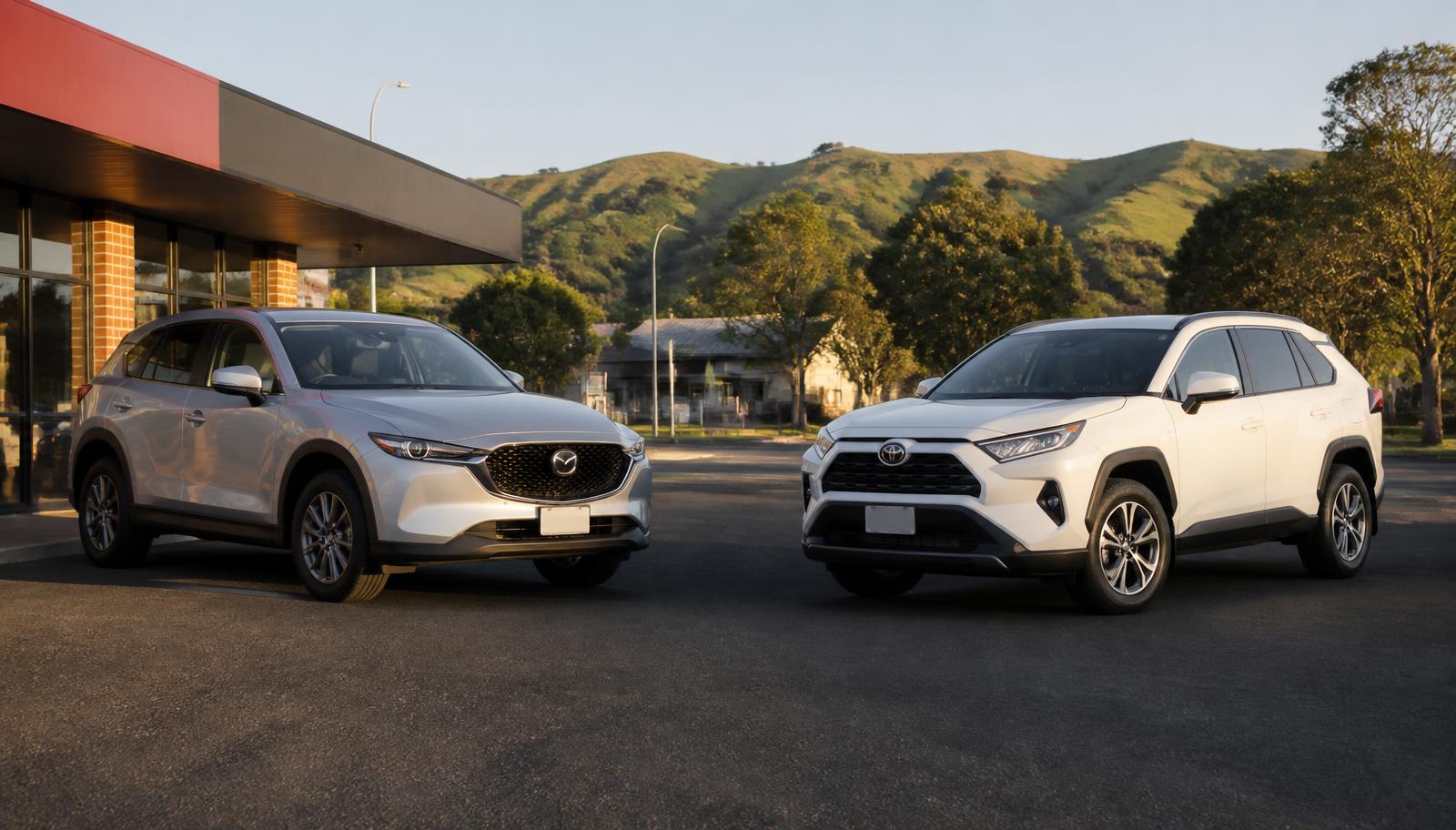
The Mazda CX-5 and Toyota RAV4 sit at the centre of the New Zealand mid-size SUV market. Both do the same core job — school run, weekend trips, occasional towing — and both are competent enough that neither is a mistake.
Which means the interesting differences are not in how they drive. They are in what they cost you over five years.
Five years of ownership, side by side
Assumptions. Both bought at three years old, held five years, 12,000 km a year (60,000 km total), petrol at $2.75/L. Prices and resale are informed New Zealand market estimates at the time of writing, not quotes.
| Cost over 5 years | CX-5 petrol 2.5 | RAV4 hybrid |
|---|---|---|
| Purchase price | $31,000 | $36,000 |
| Value after 5 years (estimate) | $15,500 | $19,100 |
| Depreciation | $15,500 | $16,900 |
| Fuel (8.2 vs 5.0 L/100km) | $13,530 | $8,250 |
| Servicing (estimate) | $3,300 | $3,200 |
| Insurance (estimate) | $5,600 | $5,900 |
| WoF and registration | $1,200 | $1,200 |
| Total | $39,130 | $35,450 |
| Cost per km | $0.65 | $0.59 |
The RAV4 hybrid is roughly $3,700 ahead over five years, or about $62 a month — despite costing $5,000 more to buy. Fuel does most of that work, and resale quietly does the rest.
Change the distance and the answer moves. At 8,000 km a year the gap narrows to around $1,900. At 25,000 km a year it widens to roughly $8,900. If your driving is mostly open-road rather than urban, trim the hybrid advantage by about a third — a hybrid recovers little energy at a constant 100 km/h.
Depreciation: the line most buyers ignore
Depreciation is the largest single cost for both cars, and the two are closer than the fuel figures suggest. Toyota's hybrid resale performance in New Zealand has been consistently strong, and the RAV4 is one of the clearest examples of it. The CX-5 holds value well too — just not quite at the same level.
Practical consequence. The RAV4's higher purchase price is only partly spent; a meaningful share of it is stored in the car and handed back at resale. If you change vehicles every three years, that matters more than fuel does.
Practicality
Boot space is close enough that most buyers will not notice day to day. The RAV4 has the slightly squarer load area, which helps with prams and flat-packed furniture. Rear-seat room favours the RAV4 marginally.
The CX-5 has the more refined cabin — better material quality, a quieter ride at speed, and a driving position that flatters the driver. On a long Desert Road run, that is not a small thing.
If you regularly carry adults in the back, sit in both before deciding. Fifteen minutes in a car park settles arguments no spreadsheet can.
Towing
Check the exact variant. Braked towing capacity varies by generation and drivetrain, and hybrid variants are not always rated the same as their petrol siblings. If you tow a boat or a trailer with any regularity, confirm the figure on the compliance plate of the specific car — not the brochure for the model range.
Safety
Both score strongly in ANCAP testing across recent generations, and both offer autonomous emergency braking, lane support and adaptive cruise on most trims sold here.
What varies is which features are standard on which trim — particularly on used imports, where Japanese-market specification can differ meaningfully from the New Zealand-new equivalent. Always check the specific vehicle rather than the model. Two same-year cars can have quite different safety equipment.
Used imports vs New Zealand-new
Both are widely available as Japanese used imports. Imports are typically cheaper for the same age and mileage, but confirm:
- the specification actually fitted, not the brochure specification
- service history, and whether it is verifiable
- whether infotainment and driver assistance operate in English and support New Zealand radio bands
- odometer verification and auction sheet, where available
- for a hybrid, a battery state of health reading — not just the dashboard estimate
A New Zealand-new car costs more up front but carries a clearer history, an easier warranty path, and generally a modest resale premium that recovers part of the difference.
AutoMatch Verdict
Neither car wins outright, and the correct answer depends almost entirely on how you drive.
- Mostly urban, 10,000 km a year or more: the RAV4 hybrid. Lower total cost, stronger resale, and the drivetrain is at its best in exactly the driving you do.
- Mostly open-road commuting: closer than you would think. The CX-5 is the more pleasant long-distance car and the fuel gap narrows considerably.
- Buying used at the lower end of the market: the CX-5 usually gets you a newer or better-specified car for the same money, because you are not paying the hybrid premium.
- Changing vehicles every three years: the RAV4, on resale alone.
- Towing regularly: check the specific variant's rating first; it may make the decision for you before cost does.
- You simply enjoy driving: the CX-5, and the roughly $60 a month is a fair price for that.
Both are sensible cars. Rank the three things that genuinely matter to you — monthly running cost, cabin comfort, boot shape, towing, purchase price — and the answer usually picks itself.
You've done the homework. Now let the right car find you.
Know what you want? Let's find it.
Tell AutoMatch what you're looking for and let the dealer network respond with suitable vehicles.
Related reading
Best station wagons in NZ 2026: 7 used wagons worth buying
Seven used station wagons compared for price, boot space, rear-seat room, fuel economy, safety and everyday practicality in New Zealand.
Find me a car in New Zealand — without searching every listing
Know the car you want, or have a shortlist? Tell AutoMatch once, let the dealer network respond with actual vehicles, and compare the strongest matches.
Best cars for older drivers in New Zealand
Easy to get into, easy to see out of, easy to park and easy to own. Six vehicles worth a look on the New Zealand market, plus the features and checks that actually matter.